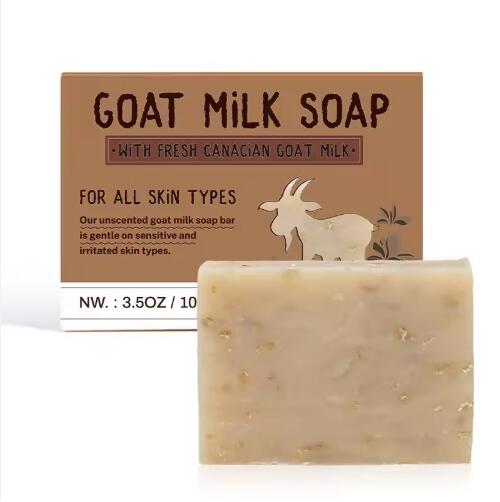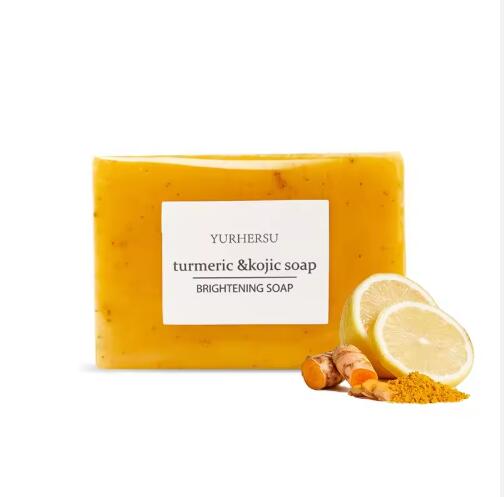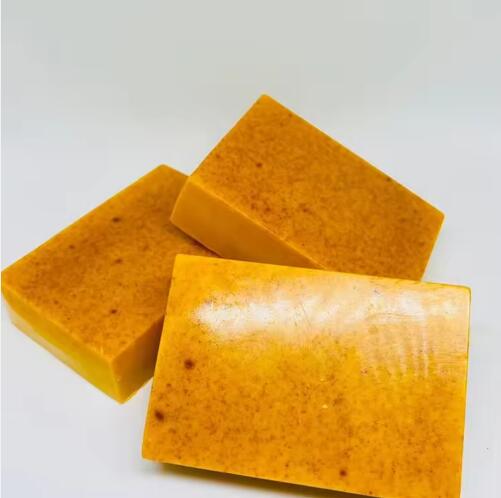

A handmade bar that leaves a Chinese factory at roughly $0.35 can retail in Europe or North America for $2.50 or more. That spread is where a soap brand lives or dies, and a well-vetted contract manufacturer is what turns it into durable margin instead of a one-off gamble.
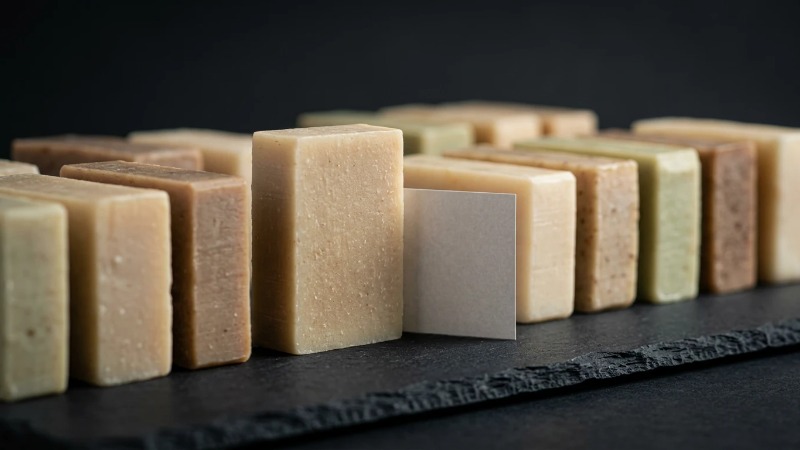
This playbook is built for decision-makers who need to move from idea to shelf-ready product without expensive detours. By the end, you will be able to shortlist, audit, and brief a factory on formulation, certification, MOQ, and lead time — and spot the red flags that sink first-time sourcing projects.
- Know your tier: White label, private label, and full OEM/ODM carry very different MOQs, lead times, and IP ownership — use the right term when you inquire.
- Certifications are non-negotiable: ISO 22716, GMPC, and SMETA signal a mature factory; verify the certificates, don't just accept a logo.
- Compliance follows the destination: EU CPNP, US MoCRA, ASEAN Cosmetic Directive, and GCC rules dictate labeling and documentation — usually the brand owner's responsibility.
- Test before you commit: Insist on physical samples plus stability testing for hardness, lather, scent throw, and shelf life.
- Cost vs. quality is a trade, not a race to the bottom: The cheapest quote rarely survives customs labeling law or a second production run.
What "Contract Soap Manufacturing" Actually Means (and Why It's Not the Same as OEM/ODM)
Contract soap manufacturing is an arrangement where a factory produces finished soap on behalf of a brand that sells it under its own name. The brand controls the label and go-to-market; the factory controls formulation know-how, sourcing, and production.
The term gets used loosely, which causes friction in early conversations. Getting the vocabulary right helps you request accurate quotes and avoid mismatched expectations on price and ownership.
White Label vs. Private Label vs. Full Custom (OEM/ODM)
White label means you buy an existing, generic formula and add your branding. The factory owns the formula; MOQs are usually the lowest and lead times the shortest because nothing is developed from scratch.
Private label is a middle path: you start from a proven base recipe and adjust scent, color, shape, or claims. The formula IP typically stays with the factory, but the finished product is uniquely yours.
Full custom (OEM/ODM) is bespoke development. In an OEM model you supply the specification; in ODM the factory designs to your brief. This route offers the strongest differentiation and clearer paths to formula ownership, but it demands higher MOQs, longer development cycles, and often tooling costs for custom molds.
Where "Contract Manufacturing" Fits for Beauty & Personal Care Brands
Four buyer profiles dominate. Indie beauty brands want small, flexible runs to test a market. Retailers want private-label lines that undercut national brands.
Hospitality buyers — hotels, spas, airlines — need consistent amenity bars at volume. Distributors serving Europe, North America, Southeast Asia, and the Middle East want a stable supply partner who can scale with reorders. Each profile weighs MOQ, customization, and lead time differently.
Why Brands Source Soap From China: The Cost, Capacity, and Capability Case
The commercial logic is straightforward: mature Chinese contract soap factories combine deep formulation libraries with automated capacity, so brands get both low unit cost and the flexibility to customize. The result is a lower barrier to launching a competitive line.
Unit Economics and Scale
Per-unit price is driven by formulation complexity, ingredient grade, packaging, and order volume. A simple syndet bar in bulk packaging sits at the low end; a cold-process bar with premium botanicals, embossing, and a printed carton climbs quickly. The table below shows illustrative ranges, not quotes — actual pricing depends on your exact brief.
| Cost Driver | Lower End | Higher End |
|---|---|---|
| Base formulation | Standard syndet / melt-and-pour | Complex cold-process with actives |
| Ingredients | Common oils, synthetic fragrance | Certified organic oils, essential oils |
| Packaging | Shrink wrap / bulk carton | Custom printed box, embossing, inserts |
| MOQ tier | Higher volume, lower per-unit | Small run, higher per-unit |
| Illustrative ex-works range | ~$0.30–$0.60 / bar | ~$1.20–$2.00+ / bar |
Treat these as planning brackets. The point is that ingredient and packaging choices, not just labor, move the number the most.
Production Capacity Realities
"High-volume handmade" is not a contradiction when a factory pairs skilled finishing with automated lines. Poleview Biotechnology Co., Ltd., founded in 2016, runs eight automatic production lines across a 30,000-square-meter facility and produces around 100,000 handmade bars per day.
That kind of throughput de-risks seasonal spikes — holiday gift sets, tourism-season hotel amenities, promotional campaigns — where a smaller workshop would miss the window. Capacity is insurance against your own success.
The Foundational Checklist: Ingredients, Formulation, and Safety
Soap sits partly in the "Your Money or Your Life" category because it touches skin and carries health-adjacent claims. Careful, substantiated language protects your brand from regulatory and reputational risk.
Reading an INCI List Before You Sign
The INCI (International Nomenclature of Cosmetic Ingredients) list is the standardized ingredient naming system used on cosmetic labels worldwide. Ask for the full INCI breakdown of any formula before committing — vague "natural blend" descriptions are a warning sign.
Know your base options. Cold process retains glycerin and suits premium artisanal positioning. Hot process speeds curing. Melt-and-pour is fast and craft-friendly. Syndet bars use synthetic surfactants for a pH closer to skin, useful for sensitive-skin positioning. Each has cost, texture, and claim implications.
Matching Formulation to Skin Type and Claims
Formulation can be tuned toward dry, oily, or sensitive skin, and toward hair or body use, by adjusting oils, superfat levels, and additives. What it cannot do is promise to treat conditions — that crosses into medical territory most jurisdictions regulate as drug claims.
Keep benefit language honest: "moisturizing," "gently cleansing," and "suitable for sensitive skin" are defensible when backed by testing. Efficacy and safety claims should be substantiated, and patch-testing plus stability testing should be standard parts of your development cycle, not optional extras.
Natural, Vegan, and Cruelty-Free — What the Labels Require
These terms carry real obligations. "Vegan" means no animal-derived ingredients — watch for tallow, honey, lanolin, or certain glycerins. "Cruelty-free" concerns testing policy. "Natural" is loosely regulated in many markets, so it needs documentary support rather than a marketing assertion.
Demand the paperwork: ingredient origin declarations, supplier statements, and, where relevant, third-party certifications. A credible factory produces these on request without hesitation.
Certifications and Regulatory Compliance by Target Market
Manufacturing and Quality Standards
ISO 22716 is the international Good Manufacturing Practice standard specifically for cosmetics, covering production, control, storage, and shipment. GMPC (Good Manufacturing Practice for Cosmetics) and GMP 211 reflect systematic quality controls. SMETA is an ethical trade audit covering labor, health and safety, environment, and business integrity.
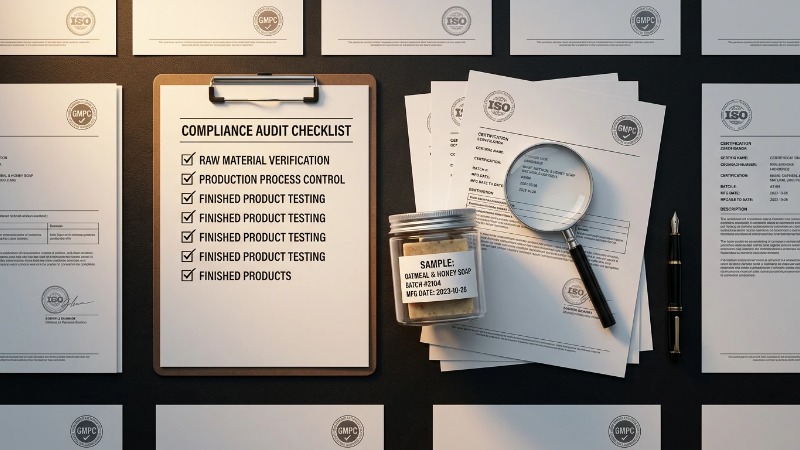
Taken together, these certifications signal a factory that has been independently examined rather than one that self-declares quality. A manufacturer holding ISO 22716, GMPC, FDA registration, and SMETA has invested in the systems that keep production consistent batch after batch.
Market-Entry Compliance
Certifications get product made; compliance gets it sold legally. Requirements differ sharply by destination, and the responsibility usually falls on the brand or its designated responsible person — not the factory.
| Region | Framework | Buyer's Core Obligation |
|---|---|---|
| European Union | EC Regulation 1223/2009; CPNP notification | Appoint an EU Responsible Person; compile a Product Information File; notify via CPNP |
| United States | FDA rules; MoCRA (Modernization of Cosmetics Regulation Act) | Facility registration and product listing; substantiate claims; adverse-event records |
| Southeast Asia | ASEAN Cosmetic Directive | Product notification per member state; conform to ingredient annexes and labeling |
| GCC / Middle East | GSO standards; national registration (e.g., SFDA) | Product registration; Arabic labeling; ingredient and claim compliance |
Confirm early who holds each obligation. A cooperative factory supplies technical documents, safety data, and specifications that feed your dossier, but it cannot act as your legal responsible person in most markets.
How to Vet and Shortlist a Contract Soap Factory (Step-by-Step)
Step 1 — Define Your Brief
Write down formula scope (base type, target claims, hero ingredients), target landed cost, a realistic 12-month volume forecast, packaging format, and destination market. A precise brief gets precise quotes; a vague one gets padded ones.
Step 2 — Verify Credentials and Audit Trail
Request current certificates, factory audit reports (SMETA is a good baseline), and two or three reference customers. Check certificate numbers against issuing bodies where possible, and ask for photos or a video walkthrough of the actual production lines rather than stock imagery.
Step 3 — Sample and Stability Testing
Clarify what is free versus paid — many factories offer free design and fast prototyping but charge for custom mold tooling. Evaluate physical samples for hardness, lather quality, scent throw, and appearance, then run stability testing to confirm the bar holds up over its intended shelf life under real temperature and humidity conditions.
Step 4 — Negotiate MOQ, Lead Time, and Terms
Discuss flexible MOQ tiers so a first order stays manageable while reorders scale. Nail down deposit structure, Incoterms (FOB and CIF are common), payment milestones, and a written on-time-delivery commitment with remedies if dates slip.
Pros & Cons of Contract Manufacturing in China
| Advantages | Considerations |
|---|---|
| Competitive unit cost at volume | Ocean freight adds transit time and logistics planning |
| Large, proven formulation libraries speed development | IP protection needs contractual safeguards (NDAs, ownership clauses) |
| High automated capacity absorbs demand spikes | Time-zone and language gaps require disciplined communication cadence |
| Deep customization from scent to packaging | Destination-market compliance remains the brand's responsibility |
| Established export experience across multiple regions | Quality depends on rigorous supplier vetting up front |
None of the considerations are dealbreakers, but each needs an owner and a plan before the first purchase order.
Common Sourcing Mistakes and How to Avoid Them
Skipping stability testing. A bar that looks perfect on day one can sweat, warp, or lose fragrance by month three. Test before you scale.
Accepting unverified certificates. A logo on a website is not proof. Validate the document and its expiry.
Underestimating packaging lead times. Printed cartons and custom molds often take longer than the soap itself. Sequence them early.
Ignoring destination labeling law. A product that passes production can still be blocked at customs over a missing Responsible Person or non-compliant ingredient statement.
Over-claiming efficacy. Promising results a cosmetic cannot legally claim invites regulatory action and erodes trust. Keep claims substantiated and modest.
Frequently Asked Questions
What is the typical MOQ for private label handmade soap?
MOQs vary widely by formula complexity and packaging. White-label runs can start relatively low, while full custom formulations with dedicated tooling require higher volumes. Ask each factory for its tiered MOQ so you can balance first-order risk against per-unit cost.
How long does custom soap manufacturing take from brief to delivery?
Development, sampling, and stability testing typically run several weeks, followed by production and ocean freight. Cold-process bars need curing time, and custom packaging can be the longest lead item. Plan on a multi-week to multi-month timeline depending on complexity and destination.
Can a factory match my existing formula or create a new one?
Both are common. An OEM engagement reproduces your specification, while ODM development builds from your brief using the factory's formulation library. Share your INCI target and desired sensory profile so the factory can confirm feasibility before you commit.
Are "100% natural" and "vegan" claims regulated?
"Vegan" and "cruelty-free" relate to defined ingredient and testing criteria, while "natural" is loosely regulated in many markets. All such claims should be backed by ingredient documentation and, where available, third-party certification rather than marketing assertion alone.
Who is responsible for regulatory compliance in my destination market?
In most markets the brand owner or its appointed responsible person carries legal responsibility — for example, an EU Responsible Person under CPNP or facility listing under US MoCRA. The factory supplies supporting technical and safety documentation but generally cannot serve as your legal responsible person.
How do I protect my formula and branding IP?
Use a signed NDA before sharing sensitive details, specify formula and artwork ownership in the manufacturing agreement, and register trademarks in your target markets. For fully custom work, negotiate explicit exclusivity and IP-assignment clauses.
Your Next Step: Brief a Factory-Direct Partner
Closing the gap between a $0.35 factory bar and a $2.50 retail unit starts with one clear brief handed to a manufacturer that can actually deliver on it. Poleview Biotechnology Co., Ltd. offers free design, fast prototyping, flexible minimum order quantities, and factory-direct pricing, backed by ISO 22716, GMPC, FDA, and SMETA credentials and capacity of around 100,000 handmade bars a day.
Serving brands across Europe, North America, Southeast Asia, and the Middle East, our R&D, sales, and service teams can match an existing formula or develop a new one to your specification. Send us your formula scope, target market, and volume forecast, and we will return a costed, compliance-aware proposal so you can move from concept to shelf with confidence.