Every bar of soap records decisions made long before the lye ever touched the oils. The hardness under your fingers, the density of the lather, whether it rinses clean or leaves skin tight—all of it traces back to which fats went into the pot and in what proportion.
This guide treats soap formulation as what it actually is: applied lipid chemistry. For soap makers moving past recipe-following toward real formulation, understanding oils and fats is the difference between predictable results and expensive guesswork.
Introduction: Why Oil Selection Is the Foundation of Every Formula
Colorants, fragrance, and technique matter, but they sit on top of a foundation determined entirely by your oil selection. No additive can rescue a bar built on the wrong base of fats in soap making.
The reason is simple. Soap is the salt of a fatty acid, and the fatty acids come from your oils. Change the oils and you change the molecule you're producing. Everything downstream—lather, longevity, mildness—follows from that chemistry.
Professionals who take this to heart stop thinking in terms of recipes and start thinking in terms of properties. That shift is what this article is built to support.
The Chemistry of Saponification: From Triglyceride to Soap
Before you can predict how a formula behaves, you need a working model of the reaction that creates soap in the first place. It's elegant, reliable, and fully quantifiable.
What Happens During Saponification
Oils and fats are triglycerides: three fatty acid chains bound to a glycerol backbone. Introduce a strong alkali—sodium hydroxide (NaOH) for bar soap or potassium hydroxide (KOH) for liquid soap—and it cleaves those bonds.
The alkali splits each triglyceride into three fatty acid salts (the soap itself) and one molecule of glycerin. That glycerin is a natural humectant, part of why handmade soap tends to feel more conditioning than mass-produced detergent bars, where glycerin is often removed.
Here's the critical insight: each fatty acid produces a soap salt with its own distinct character. A lauric acid salt behaves nothing like an oleic acid salt, which is why oil properties in soap carry so much weight.
The Role of Saponification Value (SAP)
The saponification value is the amount of alkali required to fully saponify one gram of a specific oil. It's expressed either in milligrams of KOH per gram (the classic laboratory figure) or converted to a NaOH factor for solid soap calculations.
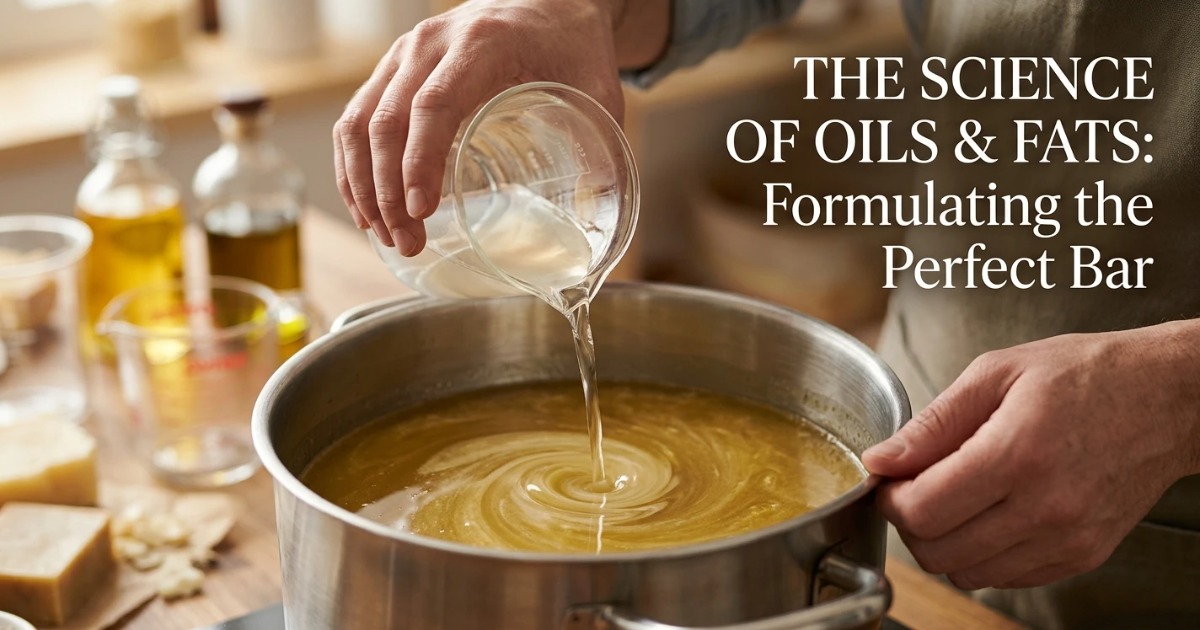
Because every oil has a unique fatty acid makeup, every oil has a unique saponification value. Coconut oil, rich in short-chain lauric acid, demands more lye per gram than olive oil, which is dominated by longer-chain oleic acid.
This single number is what makes formulation a science rather than a gamble. It tells you precisely how much alkali a given fat will consume.
Calculating the Correct Lye and Oil Ratio
Getting the lye and oil ratio right is non-negotiable. Too much lye leaves free alkali in the bar, producing a harsh, potentially caustic product that can irritate or burn skin. Too little leaves excess oil and a soft, greasy, quick-to-spoil bar.
To calculate the required alkali, multiply the weight of each oil by its SAP value, then sum the results. Reliable lye calculators automate this, but the logic matters: swap an oil without recalculating and your entire balance breaks.
This is also why you can never substitute one oil for another at equal weight and expect equal results. Different SAP figures mean different alkali requirements, every time.
Fatty Acid Composition: The DNA of Your Soap
If saponification is the mechanism, fatty acid composition is the blueprint. It's the single most predictive factor for how a finished bar will perform.
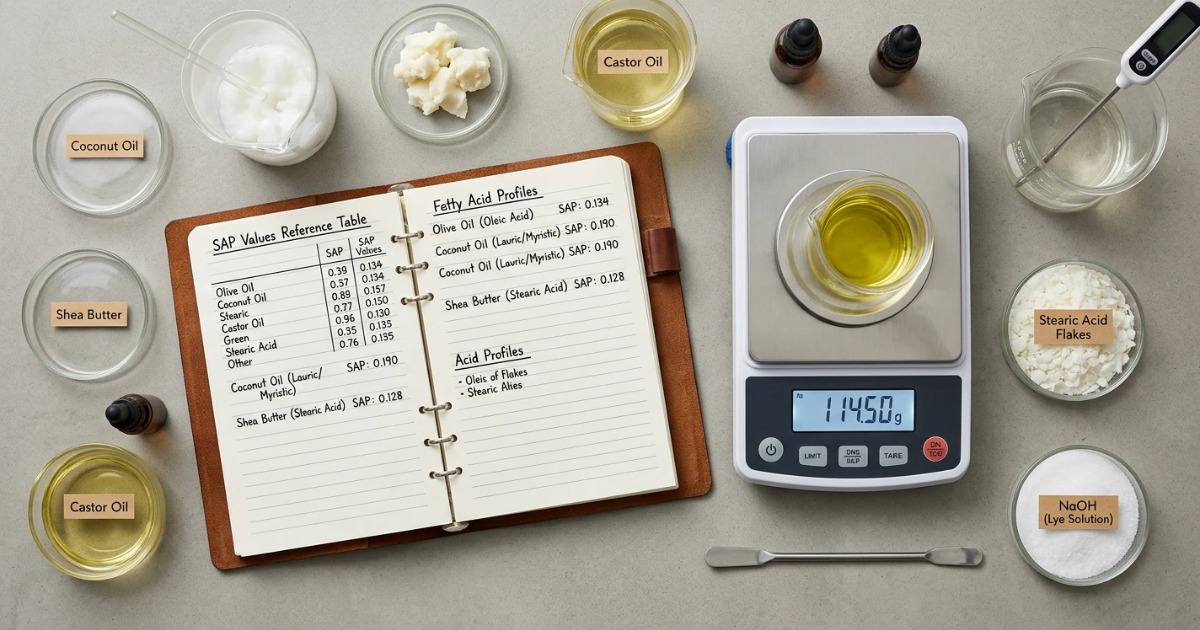
The Key Fatty Acids and Their Functions
Seven fatty acids account for the behavior of nearly all common soap making oils. Learn their individual roles and you can read any oil's data sheet and forecast its contribution.
- Lauric acid — a saturated, short-chain acid that delivers hardness and abundant, fluffy bubbles. High levels also make a bar strongly cleansing, sometimes to the point of drying.
- Myristic acid — similar to lauric, contributing hardness and bubbly lather with strong cleansing action.
- Palmitic acid — a saturated acid that adds hardness and a stable, creamy lather without excessive cleansing.
- Stearic acid — brings hardness and creamy, lasting lather; a defining component of butters like cocoa and shea.
- Oleic acid — a monounsaturated acid that is deeply conditioning and gentle, though it contributes little lather and adds softness rather than hardness.
- Linoleic acid — a polyunsaturated acid that is conditioning and silky but oxidizes readily, shortening shelf life.
- Ricinoleic acid — the unusual acid found almost exclusively in castor oil, which boosts lather and conditioning in a way no other fatty acid replicates.
Fatty Acid Profile Reference Table
The table below maps each fatty acid to the qualities it contributes. Use it as a lens when evaluating any oil.
| Fatty Acid | Hardness | Cleansing | Bubbly Lather | Creamy Lather | Conditioning |
|---|---|---|---|---|---|
| Lauric | High | High | High | Low | Low |
| Myristic | High | High | High | Low | Low |
| Palmitic | High | Low | Low | High | Moderate |
| Stearic | High | Low | Low | High | Moderate |
| Oleic | Low | Low | Low | Low | High |
| Linoleic | Low | Low | Low | Low | High |
| Ricinoleic | Low | Low | High | High | High |
Saturated vs. Unsaturated: Hardness and Shelf Life Tradeoffs
Saturated fatty acids—lauric, myristic, palmitic, stearic—have straight molecular chains that pack tightly. The result is firm bars that resist dissolving. They're also chemically stable and resist oxidation.
Unsaturated fatty acids—oleic, linoleic, linolenic—have kinked chains from their double bonds. They yield softer, more conditioning bars, but they're vulnerable to oxidation, which causes rancidity.
Polyunsaturated acids are the most reactive. High linoleic and linolenic content is the leading cause of the orange oxidation spots known as dreaded orange spots (DOS). Balancing saturation against conditioning is one of the central tensions in formulation.
How Common Oils Perform in Soap
With the chemistry established, here is how the workhorse oils actually behave in a bar. Think of these as building blocks with defined structural roles.
Hard Oils and Butters
Coconut oil is the industry's cleansing and lather powerhouse, loaded with lauric and myristic acids. It hardens bars quickly and produces big bubbles. But used above roughly 30 percent, it becomes drying.
Palm oil offers a balanced palmitic and oleic profile that adds hardness and a stable lather; sustainably sourced palm remains a formulation staple. Tallow and lard are traditional animal fats, rich in palmitic and stearic acids, that create hard, mild, creamy bars economically.
Cocoa butter and shea butter bring hardness plus luxurious conditioning. Cocoa butter's high stearic content firms the bar, while shea butter's unsaponifiable fraction adds a rich, moisturizing feel.
Soft and Liquid Oils
Olive oil is the classic conditioning oil, almost pure oleic acid, producing exceptionally mild bars—though on its own it cures slowly and lathers modestly. Sunflower and canola oils are affordable, high-oleic options that add conditioning without dominating cost.
Sweet almond oil lends a silky, gentle feel prized in facial and sensitive-skin formulas. Avocado oil is rich in oleic acid and unsaponifiables, contributing a creamy, nourishing quality valued in premium bars.
Specialty Oils
Castor oil is the standout specialty ingredient. Its ricinoleic acid dramatically boosts lather volume and stability, making it a near-universal small-percentage addition. It stays in a supporting role because too much makes bars soft and sticky.
Premium oils such as jojoba, hemp seed, and various nut oils appear in luxury and niche formulations for their skin-feel and marketing appeal, typically used in modest amounts to protect both performance and margins.
Oil Properties Comparison Table
The values below are representative reference figures. Always confirm the exact SAP for your specific supplier's oil before finalizing a batch.
| Oil/Fat | SAP (NaOH) | Dominant Fatty Acids | Primary Contribution | Recommended Max % |
|---|---|---|---|---|
| Coconut Oil | 0.178 | Lauric, Myristic | Cleansing, bubbly lather, hardness | 30% |
| Palm Oil | 0.142 | Palmitic, Oleic | Hardness, stable lather | 40% |
| Tallow | 0.140 | Palmitic, Stearic, Oleic | Hardness, creamy mild lather | 60% |
| Cocoa Butter | 0.137 | Stearic, Palmitic | Hardness, conditioning | 15% |
| Shea Butter | 0.128 | Oleic, Stearic | Conditioning, creamy feel | 20% |
| Olive Oil | 0.134 | Oleic | Conditioning, mildness | 100% |
| Sweet Almond Oil | 0.136 | Oleic, Linoleic | Conditioning, silky feel | 25% |
| Avocado Oil | 0.133 | Oleic | Conditioning, nourishing | 25% |
| Castor Oil | 0.128 | Ricinoleic | Lather boosting | 10% |
Balancing a Formula: Translating Oil Properties Into Bar Performance
Understanding individual oils is only half the discipline. Formulation is the art of combining them so their strengths compound and their weaknesses cancel.
Optimizing for Soap Hardness and Lather
Soap hardness and lather are the two most immediately noticeable qualities, and they come from different sources. Hardness derives largely from saturated acids in your hard oils, while lather is a blend of bubbly (lauric/myristic) and creamy (palmitic/stearic) contributions.
A common professional starting point pairs a base of hard oils for structure with a lather booster like castor oil at 5 percent. This gives a bar that is durable, releases from the mold cleanly, and lathers convincingly.
The trap is chasing hardness through coconut oil alone, since its cleansing action climbs alongside its hardness. Palm, tallow, or lard provide firmness with a gentler profile, letting you harden the bar without stripping the skin.
Cleansing Power vs. Skin Conditioning
Cleansing and conditioning pull in opposite directions. High-cleansing oils strip oils from the skin efficiently, but past a certain point that same action removes the skin's protective barrier and causes tightness.
Conditioning oils, dominated by oleic and linoleic acids, leave a gentle, moisturizing film. A well-balanced bar cleanses adequately while preserving comfort—which usually means keeping high-lauric oils in a supporting rather than starring role.
Recommended Property Target Ranges
Most lye calculators express predicted qualities as numeric values. The ranges below represent widely accepted targets for a balanced, all-purpose bar.
| Property | Recommended Range | Notes |
|---|---|---|
| Hardness | 29–54 | Higher values cure faster and last longer |
| Cleansing | 12–22 | Above 22 risks drying; 0 is possible but very mild |
| Conditioning | 44–69 | Higher means gentler but softer |
| Bubbly | 14–46 | Governs large, fluffy bubble formation |
| Creamy | 16–48 | Governs dense, lotion-like lather stability |
Superfatting and Lye Discount Strategy
Superfatting is the deliberate practice of using less alkali than would fully saponify all the oils, leaving a fraction unreacted. It's one of the most powerful levers you have for skin feel.
Superfatting in Cold Process
In cold process, a superfat of 5 percent is the standard baseline. Those leftover free oils act as emollients, improving mildness and moisturization while providing a safety margin against measurement error.
Higher superfats—8 to 15 percent—suit facial and sensitive-skin bars where gentleness matters most, though they trade away some hardness and lather and shorten shelf life. For heavily used utility bars, some formulators drop toward 3 percent for a harder, longer-lasting result.
When superfatting in cold process, remember that you cannot choose which oils stay unsaponified; the reaction consumes fatty acids somewhat indiscriminately. To reserve a specific luxury oil, hot process gives you more control.
Adjusting Lye for Hot Process and Liquid Soap
Hot process cooks the soap to accelerate saponification, letting you add a chosen superfatting oil after the cook so it survives intact. This is the reliable way to feature a delicate oil's benefits.
Liquid soap uses KOH instead of NaOH and follows different math, since KOH has a higher molecular weight. Liquid formulations often run a slight lye excess or a very low superfat to avoid cloudiness, so SAP calculations must use KOH values specifically.
Common Formulation Pitfalls and How to Avoid Them
Experience is often just a catalog of mistakes already made. Here are the two that most frequently undermine otherwise sound formulas.
Rancidity, DOS, and Oxidation Risks
Oils high in linoleic and linolenic acids—grapeseed, hemp, sunflower, rice bran—oxidize over time, producing rancid odors and the orange oxidation spots known as DOS. The higher the polyunsaturated content, the shorter the practical shelf life.
Mitigation starts with capping high-linoleic oils at modest percentages and prioritizing fresh stock with distant best-by dates. Adding an antioxidant such as rosemary oleoresin extract or vitamin E slows oxidation, and storing bars in a cool, dry, well-ventilated space extends their life considerably.
Overuse of High-Cleansing Oils
The most common beginner error is leaning too hard on coconut oil for its fast hardening and generous bubbles. The result is a bar with a cleansing value well above the comfortable range that leaves skin feeling stripped and tight.
The fix is to hold coconut oil near 20 to 30 percent and build hardness with palm, tallow, lard, or butters instead. If a high-coconut bar is unavoidable, a higher superfat of 15 to 20 percent can partially offset the drying effect.
Frequently Asked Questions
Why can't I swap one oil for another using the same lye amount?
Because each oil has a different saponification value. The lye quantity in any recipe is calculated specifically for the oils listed, based on how much alkali each gram consumes. Substitute an oil with a different SAP without recalculating and you'll end up with either excess lye or excess unsaponified oil, both of which compromise the bar.
What is the ideal balance of hard to soft oils?
A reliable starting point is roughly 60 percent hard oils to 40 percent soft oils, though this shifts with your goals. Hard oils provide the structure, quick cure, and longevity; soft oils deliver conditioning and mildness. Skew toward hard oils for durable utility bars and toward soft oils for gentle facial bars, then verify the predicted property values fall within recommended ranges.
How does castor oil improve lather without hardening the bar?
Castor oil is unique because of its ricinoleic acid, a fatty acid found in virtually no other common oil. Ricinoleic acid attracts and holds water molecules, stabilizing and boosting lather while conditioning at the same time. Because it doesn't contribute the saturated chains that create firmness, it enhances bubbles without adding hardness—which is exactly why it works best as a 5 to 10 percent supporting ingredient rather than a base oil.
Can I make soap from a single oil?
Yes, and the classic example is a 100 percent olive oil castile soap, which is exceptionally mild. But single-oil bars inherit all of that oil's limitations: castile cures slowly and lathers modestly, while a pure coconut bar would be harshly drying. Blending oils lets you balance strengths, which is why most professional formulas combine three to five oils.
How do I extend the shelf life of oil-rich soaps?
Concentrate on three things. First, choose oils rich in stable saturated and monounsaturated acids, and go easy on high-linoleic oils that oxidize fast. Second, add an antioxidant like rosemary oleoresin extract or vitamin E, and work with fresh oils that have plenty of shelf life left. Third, cure and store your bars somewhere cool, dry, and well-ventilated, away from direct light and heat. This slows the oxidation behind rancidity and DOS.
Master the lipid chemistry and formulation stops being a matter of luck. Once you can read a fatty acid profile and predict the bar it will make, every ingredient becomes a deliberate choice in service of the result you want.