You use it every day. You lather it on your hands, scrub it across dishes, and trust it to make things clean. But have you ever stopped to wonder how soap actually works? The answer involves clever chemistry, tiny molecular structures, and a process that's far more fascinating than most people realize.
What Exactly Is Soap? A Quick Chemistry Primer
At its core, soap is a salt made from fatty acids. It's created through a chemical reaction called saponification, where fats or oils are combined with an alkali like sodium hydroxide (lye). The result is a collection of surfactant molecules — compounds specifically designed by nature and chemistry to interact with both water and oil.
Humans have been making soap for thousands of years. Ancient Babylonians were producing it as early as 2800 BCE. Yet despite its long history, most people have no idea why it cleans so effectively. The secret lies in the unique structure of each soap molecule.
The Two-Faced Molecule — Hydrophobic and Hydrophilic Ends
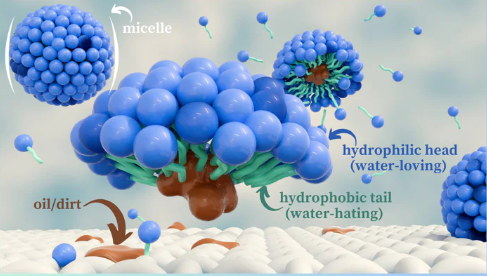
Every soap molecule has a split personality. One end is hydrophilic, meaning it loves water and is attracted to it. The other end is hydrophobic, meaning it repels water but is strongly attracted to oils, fats, and grease.
Think of it like a matchstick. The head of the match is the water-loving end, eager to dissolve into water. The wooden tail is the oil-loving end, desperate to bury itself in grease. This hydrophobic hydrophilic dual nature is the entire reason soap can do what plain water cannot.
How Soap Actually Removes Grease and Dirt
The cleaning process isn't magic — it's a well-orchestrated three-step sequence that happens every time you lather up. Here's what occurs the moment soap meets a greasy dish or dirty skin.
Step 1 — Surface Tension Reduction
Plain water has high surface tension. That's why water beads up on a greasy pan instead of spreading out and making contact. The water molecules cling tightly to each other, forming droplets that roll right off oily surfaces.
Soap changes this dramatically. When soap dissolves in water, its surfactant molecules wedge themselves between water molecules, breaking those tight bonds. This surface tension reduction allows soapy water to spread flat across surfaces, reaching into crevices and making full contact with grime. It's why soapy water feels "wetter" and slipperier than plain water.
Step 2 — Surrounding the Grime — Micelle Formation
Here's where the real action happens. As soap molecules encounter grease and oil on a surface, they begin to organize themselves into tiny spherical structures called micelles.
During micelle formation, the hydrophobic tails of the soap molecules point inward, plunging into the grease particle. The hydrophilic heads face outward toward the surrounding water. The result is a microscopic cage — a sphere of soap molecules with trapped oil and dirt locked inside.
Each micelle is essentially a delivery package: grease on the inside, water-friendly coating on the outside. This makes the trapped grime fully soluble in water for the first time.
Step 3 — Lifting and Washing Away
Once micelles form, the trapped grease and dirt particles are suspended in the water. They float freely, unable to reattach to the surface you're cleaning. This is the critical step in grease and dirt removal — the grime is now a passenger in the water, not a resident on your hands or dishes.
Rinsing carries everything down the drain. Scrubbing and mechanical action help by physically dislodging stubborn particles, giving soap molecules better access to trapped oils. That's why a quick splash of soapy water is never as effective as a thorough lather and scrub.
Soap vs. Germs — Why Soap Destroys Bacteria and Viruses
Soap doesn't just remove visible grime. It's also a powerful weapon against many disease-causing pathogens. Many bacteria and viruses — including enveloped viruses like influenza and coronaviruses — are surrounded by a lipid (fatty) membrane. This membrane is their armor, holding the pathogen together.
The hydrophobic tails of surfactant molecules pry apart these fatty outer layers, effectively ripping the pathogen apart at a molecular level. The virus or bacterium disintegrates, and the remnants are washed away in micelles along with everything else.
This is why public health authorities consistently recommend washing hands with soap and water for at least 20 seconds. That duration gives the soap molecules enough time to dismantle pathogens and form micelles around them.
Why Soap Often Outperforms Hand Sanitizer
Alcohol-based hand sanitizers are convenient, but they have limitations. Sanitizers work by denaturing proteins in some germs, but they cannot neutralize certain stomach viruses (like norovirus) or bacterial spores (like Clostridioides difficile).
Soap and water, by contrast, physically remove these pathogens from the skin — even if it doesn't kill them directly, it washes them away. Soap is also effective against a broader range of germs overall. Sanitizer works in a pinch when a sink isn't available, but it's not a full substitute for proper handwashing.
Bar Soap vs. Liquid Soap vs. Detergent — What's the Difference?
All three rely on the same fundamental hydrophobic hydrophilic principle, but their formulations differ:
| Type | How It's Made | Best For |
|---|---|---|
| Bar Soap | Traditional saponification with sodium hydroxide | Handwashing, body washing |
| Liquid Soap | Similar chemistry using potassium hydroxide | Handwashing, convenience |
| Detergent | Synthetic surfactant molecules engineered for specific tasks | Laundry, dishwashing, hard water |
Detergents were specifically developed to overcome some of soap's weaknesses, particularly its poor performance in hard water. But at the molecular level, all three products use surfactants to trap and remove grease and dirt.
Does "Antibacterial" Soap Work Better?
This is one of the most common consumer questions — and the answer may surprise you. Studies and FDA findings have shown that antibacterial additives like triclosan offer no significant advantage over regular soap for everyday handwashing. Triclosan has been largely phased out of consumer products due to concerns about antibiotic resistance and environmental impact.
Plain soap with proper technique — 20 seconds of thorough lathering — is sufficient for removing and destroying the vast majority of harmful pathogens.
Common Mistakes That Make Soap Less Effective
Even the best soap can't do its job if you're using it incorrectly. Here are the most common mistakes consumers make:
- Not washing long enough — A quick two-second rinse doesn't give micelle formation enough time to work.
- Using too little soap — You need enough surfactant molecules to tackle the amount of grease and grime present.
- Skipping key areas — Fingertips, thumbs, between fingers, and under nails are frequently missed.
- Rinsing too quickly — Incomplete rinsing leaves suspended dirt on the skin instead of carrying it away.
- Ignoring hard water issues — Mineral-rich water can significantly reduce soap's cleaning power.
Hard Water and Soap Scum — What's Happening?
If you've ever noticed a white, chalky film on your shower doors or faucets, you've seen soap scum. This happens when calcium and magnesium ions in hard water react with soap molecules to form an insoluble residue.
Instead of forming micelles and trapping dirt, the soap binds with minerals and falls out of solution as a sticky film. This reduces cleaning effectiveness considerably. Detergents were engineered specifically to resist this reaction, which is why they perform much better than traditional soap in hard water conditions.
Frequently Asked Questions (FAQ)
Can water alone clean as well as soap?
No. Water alone cannot dissolve oils and grease because oil and water don't mix. Soap acts as a molecular bridge between the two, making grease and dirt removal possible through micelle formation. Without soap, greasy residues simply stay put.
Is hot water necessary for soap to work?
Hot water helps dissolve soap faster and can loosen grease, but soap works effectively at any temperature. Cold water with soap is still far more effective at cleaning than hot water alone. Use whatever temperature is comfortable.
Does the type of soap matter for killing germs?
For everyday handwashing, regular soap is just as effective as antibacterial soap. The mechanical action of lathering, scrubbing, and rinsing is what removes and destroys most pathogens. Specialty soaps offer no meaningful advantage for routine hygiene.
Why does soap create bubbles?
Bubbles form because soap reduces surface tension, allowing water to stretch into thin, flexible films that trap air. Bubbles are a visible sign that surfactant molecules are active in the water. However, more bubbles don't necessarily mean better cleaning — it simply means surfactants are present.
Can you use too much soap?
Yes. Excess soap can leave residue on skin or surfaces and may be harder to rinse away completely. It can also dry out skin by stripping away natural protective oils. A moderate amount with thorough lathering is more effective than an excessive squirt.
The next time you wash your hands or tackle a sink full of dishes, you'll know exactly what's happening at the molecular level — tiny two-faced molecules working tirelessly to trap, lift, and wash away everything you want gone.